
The outward 94 bus route.
OUTWARD TOUR: FROM PICCADILLY CIRCUS TO ACTON GREEN
LINK TO LIVE DEPARTURES AT TRANSPORT FOR LONDON WEBSITE
STOP 1: CHARLES II STREET
The Outward Journey starts south of Piccadilly Circus at Charles II Street. Departures are about every fifteen minutes. The live departure times are shown at this LINK.
THE DUKE OF YORK COLUMN

The bus turns north. On your left is the tall monument to Frederick, Duke of York. He commanded the British Army during the 18th century French Revolutionary Wars.
-
When the Duke of York died in 1827, the entire British Army, by general consensus following a proposal of the senior officers, forwent one day's wages to pay for a monument to the Duke. It was completed in 1834.
The column, which is built of granite from Aberdeenshire, together with the statue, which is twice life size, rises to a combined height of 137 feet.
It just predates Nelson’s Column in Trafalgar Square, which was completed in 1843 and rises to 170 feet. London has no later examples of statues on absurdly tall plinths.
If you have a head for heights you can climb Nelson’s Column on a ladder in this VIDEO. For the Wikipedia article on the Duke of York Column, follow this LINK.
STOP 2: REGENT STREET/ST. JAMES’S
THE MICROCOSM


You pass on your right, at the junction of Regent Street and Jermyn Street, the site of the home and museum of the celebrated 19th century optical engineer Philip Carpenter.
-
His shop and and an example of his work are seen above. Originally based in Birmingham, he was a leading maker of microscopes, kaleidoscopes, and magic lanterns. Visitors could observe, at enormous magnification on a screen nine feet in diameter, the teeming life in Thames water.
As well as being a brilliant engineer, Carpenter was a showman with an infectious enthusiasm for the wonders of nature.
He charged a shilling admission to an upstairs museum, called the Microcosm, which enabled visitors to marvel at tiny objects. It was described thus in the Morning Post:
An announcement in The Morning Post in June 1827 shows that there were initially twelve microscopes, exhibiting ‘the wonders of nature on a magnitude never before attempted’. This was later expanded to fourteen and supported by various other effects and multiple compound microscopes. The microscopes were powered by the Sun during the day, but gas-powered after dark, giving continuous projections from eleven until eight each day. Visitors would view enlarged cheese-mites and aquatic creatures. An advert in The Morning Post says that ‘a single drop of water, filled with innumerable living creatures, occupies a space nine feet in diameter’.
Carpenter published a companion booklet that described the different objects on view. Companion to the Microcosm lists seven transparent insects, five worms and 49 opaque objects, including beetles, earwigs, locusts, fleas, corals and lizard skin. These were varied regularly in the fourteen available microscopes.
The Spectator wrote of the experience in 1830:
The instrument has !hree magnifiers, of different degrees of power : the lowest magnifies the object 32,000 times; the next 83,000; and the highest half a million.
With this immense power, a portion only of the eve of a fly is shown, nine feet in diameter! the numerous little transparent lenses of which it is composed appearing beautifully distinct and perfectly defined.
A piece of the finest cambric, shown under this magnifying power, looks like the iron grating of a prison!
The living scenes are by far the most amusing. In the drop of water, nine feet in diameter, will be seen the Dytiscus, or water-beetle,—a formidable and voracious insect, with forked pincer-like jaws, with which it fastens upon the fish to suck the juices out of its body.
STOP 3: PICCADILLY CIRCUS
THE EROS STATUE

In Piccadilly Circus is the memorial to the 7th Lord Shaftesbury. He campaigned for better working conditions, reform to lunacy laws, education and limitation of child labour.
-
There are two remarkable things, and one confusing thing, about the statue, known as Eros.
It is remarkable because when unveiled in 1893 it was the first statue in London to be made of aluminium, then a relatively novel material.
The second remarkable thing is that Eros stands perched on the toes of one foot, and it is surprising that the comparatively substantial weight of his body, wings and bow do not cause him to fall over in a high wind.
The confusing thing is the unclear identity of the figure. Eros seems hardly appropriate as a memorial to Lord Shaftesbury, since Eros is the god of erotic lust. The brother of Eros, Anteros, is the god of selfless love, which seems much more appropriate, but that name has not stuck.
Here is a VIDEO about the Eros statue. Here is a VIDEO of a Second World War film evoking Piccadilly. And here is a LINK to the Wikipedia article on the 7th Lord Shaftesbury, a great reforming politician.
picadilly circus advertisinG SIGNS


Piccadilly Circus, like Times Square in New York, is famous for its neon. In 1904 Mellins Food erected the first electric sign. In 1910 Bovril became the first to use a neon sign.
-
Neon signs continued for almost a century, being succeeded by digital signs in the 2000s.
Here is a VIDEO from the 1950s showing the craftsmanship involved in making neon signs. Neon survived for almost 100 years, but in the early 2000s was overtaken by digital LED displays, the last neon sign being removed in 2011. In 2017 there was installed at Piccadilly Circus Europe’s largest LED display, above.
Here is a VIDEO about its launch.
PICCADILLY CIRCUS UNDERGROUND STATION


Under Piccadilly Circus is a notable underground station, originally built, above ground, in 1906. An underground booking hall, and nine new escalators, were added in 1928.
-
The re-building of the station was required to accommodate a greatly increasing number of passengers. The design of the new underground booking hall was by Charles Holden, who designed many notable London underground stations of the 1920s. For Piccadilly Circus he adopted an appropriaely circular design, with elegant fluted colums.
The construction necessitated the removal of the Eros statue to the Victoria Embankment while the works took place.
In the Second World War underground stations were used as air raid shelters during the Blitz. The image below from one such shelfter shows children sleeping in hammocks slung between the underground rails.

REGENT STREET

Leaving Piccadilly Circus, you enter Regent Street - one of the grandest shopping streets in London. It was laid out in 1825 by the architects John Nash and James Burton.
-
They were also responsible for the fine terraces around Regent’s Park. The street and the park were named after the Prince Regent, later George IV.
Although the layout of Regent Street has survived, all the original buildings were replaced with larger buildings in the late 19th century.
Here is a LINK to the Wikipedia article on John Nash.
STOP 4: CONDUIT STREET/HAMLEYS TOY STORE
HAMLEYS TOY STORE

On your right, Hamleys is reputedly the largest toy shop in the world. It is named after William Hamley, who founded a toy shop called "Noah's Ark" at High Holborn, in 1760.
-
Ownership of the shop passed through the family. By the time it was operated by Hamley's grandsons, in 1837, the store had become famous, counting royalty and nobility among its customers. The Hamleys opened the Regent Street shop in 1881.
Here is a VIDEO that takes you inside Hamleys.
THE COSMORAMA


Past Hamleys, on your left, is the site of the Cosmorama Rooms. These offered the viewing of scenes through enlarging lenses, and the observation of large or small people.
-
The following description of the Regent Street Cosmorama is extracted from Curiosities of London, published by John Timms in 1867:
'The Cosmorama is an enlargement of the street peep-show; the difference not being in the construction of the apparatus, but in the quality of the pictures exhibited.
The oil paintings are placed beyond what appear like common windows, but of which the panes are really large convex lenses, fitted to correct the errors of appearance which the nearness of the pictures would else produce.
The optical part of the exhibition is thus complete; but as the frame of the picture would be seen, and thus the illusion be destroyed, it is necessary to place between the lens and the view a square wooden frame, which, being painted black, prevents the rays of light passing beyond a certain line, according to its distance from the eye: on looking through the lens, the picture is seen as if through an opening, which adds very much to the effect.
Upon the top of the frame is a lamp, which illuminates the picture, while all extraneous light is carefully excluded.
A Cosmorama was long shown at Nos. 207 and 209, Regent-street, where the most effective scenes were views of cities and public buildings from around the world.'
Alongside this somewhat educational activity, the Cosmorama Rooms offered the opportunity to see in the flesh people who were freakishly large or small. Examples are above.
LIBERTY STORE

Glimpse on your right, down Great Marlborough St, the half-timbred 1924 Libertys store. A temple to the Arts & Crafts movement, its timbers came from wooden naval ships.
-
Libertys became in the late 19th century the temple of the Arts & Crafts movement. A surprising feature of the building, which was constructed in 1924, is that the timbers for the facade of the building came from two dismantled wooden naval ships - HMS Impregnable and HMS Hindustan.
Libertys was not just a store, but produced its own fabrics, including many designs by William Morris. Liberty continues to produce its own fabrics at its Liberty Printing Mill, near Lake Como in Italy, as this VIDEO shows.
For the Wikipedia article on the history of the Libertys store, follow this LINK.
STOP 5: OXFORD CIRCUS STATION
THE SCRAMBLE CROSSING AT OXFORD CIRCUS

At Oxford Circus, you pass through a 6-way ‘scramble’ pedestrian crossing, modelled on one in Tokyo. In this VIDEO mayor Boris Johnson opens it by striking a large gong.
-
The scramble crossing was opened in 2012 by Mayor Boris Johnson who struck a huge gong as Japanese musicians played taiko drums.
Watch this bizarre ceremony on a fuzzy VIDEO. Oxford Circus is used at its peak by 43,000 people and 2,000 vehicles an hour.
THE TWIST MUSEUM


As you turn left at Oxford Circus, you see on your right the modest entrance to the TWIST Museum. A commercial enterprise, it offers visitors immersion in large optical illusions.
-
The illusions are housed in the extensive basement. An example is shown in the second image above. TWIST introduces itself thus: ‘Our senses are amazing. They have evolved to allow us to accurately experience a huge range of things – colours, shapes, sounds, textures, tastes, smells, heat, location, direction. Not only this, but we can accurately experience these things in very different conditions, from bright sunlight to the glow of a TV, from sweltering heat to frost, underwater, zooming past things in a car… the way our senses can adapt is remarkable. But because our senses are so powerful and flexible, very rarely… they get it wrong. This creates an illusion – when we fail to perceive things accurately and experience things that aren’t there.’
TWIST is an interesting example of the way that, under the pressure of competition from the internet, retail premises are turning retail into an experience, or even moving to selling experiences rather than goods, as a theatre or cinema would.
Here is a LINK to the TWIST Museum website.
STOP 6: OXFORD STREET/JOHN LEWIS
THE JOHN LEWIS DEPARTMENT STORE

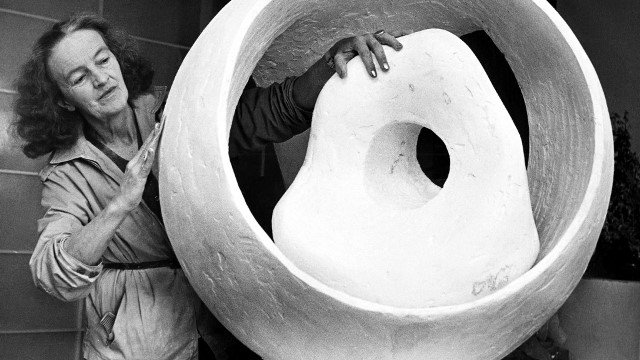
John Lewis, on your right, is a monument to philanthropy. John Spedan Lewis inherited the business from his father in 1929, and began distrsiuting profits to employees.
-
John Spedan Lewis transferred the whole business to the employees in 1950. He made arrangements for the employees (known as partners) to be paid an annual profit share pro rata to their salaries, and to control the business.
He also invested heavily in the well being of the partners, including the provision of holiday hotels for their exclusive use, in the Lake District and at Brownsea Island in Poole Harbour.
The present John Lewis store in Oxford Street ws built in 1960. Spot on its corner the 1961 Winged Figure sculpture, 19 feet high, by Barbara Hepworth. She is shown in her studio above.
Watch a VIDEO about Barbara Hepworth’s work. And this VIDEO takes you on a walk through the John Lewis store.
THE HMV BUILDING
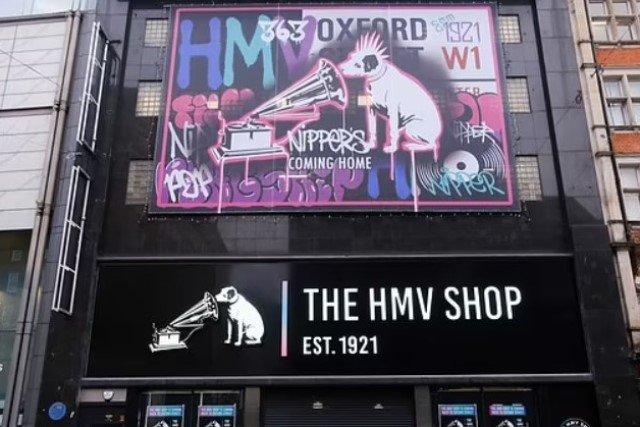

On your left just before Bond Street underground, is the HMV store. Opened in 1921, it became a mecca for those buying gramophones and records. It has been re-born.
-
HMV was recently bought out of bankruptcy by Canadian entrepreneur Doug Putman, who tells the story in this VIDEO.
The original His Master’s Voice store, selling gramophones and gramophone records, opened on this site in 1921. It closed in 2019 when the HMV chain went bankrupt under the impact of internet streaming of music and films. It re-opened under Putnam’s ownership in 2013.
THE ORIENTAL CLUB


Opposite Bond Street underground station is Stratford Place. At the end is the Oriental Club, set up in 1824 as a gathering place for officials returning from work in the East Indies.
-
London’s numerous 19th century gentlemen’s clubs (now open to women members) continue to thrive as curious relics of empire. Other examples are given at this LINK. When the Oriental Club was founded in 1824, the annual subscription was £6; it is now over £2,000. The club bought and moved to Stratford House in 1961.
The very grand building was designed by Robert Adam, and was built between 1770 and 1776 for Edward Stratford, 2nd Earl of Aldborough. It subsequently passed through the ownership of the son of the Russian Tsar Nicholas I, the Liberal politician Sir Edwrd Colebrook, and Lord Derby. When the Oriental Club bought the premises they undertook substantial works including the installation of lifts, and the conversion of the ballroom into two floors of bedrooms.
THE ELIZABETH LINE


Bond Street underground station, on your left, is an entrance to the spectacular Elizabeth Line, opened in 2022. Unlike the rest of the underground, it runs full sized trains.
-
The use of full sized trains required tunnels much larger than those of London's previous deeply tunnelled underground lines. The standard Elizabeth Line tunnel diameter is 6.2 metres, compared to 3.5 metres for the Central line.
Eight giant tunnel boring machines, built by the German firm Herrenknecht, were used. Each machine was 150 metres long, and weighed around 1,000 tons. They operated 24 hours a day. The movement of the tunnel boring machines was carefully monitored to ensure they remained on target. Each week they could ravel between 90 and 150 metres, ending up within a millimeter of where they needed to be.
Here is a LINK to the Wikipedia article on the Elizabeth Line. And here is a VIDEO taking you on a light-hearted tour of the Elizabeth Line.
THE CANDY STORE CURSE

The internet and COVID caused many Oxford St shops to close down in the early 2020s. There broke out a rash of candy shops, known for high prices and counterfeit goods.
-
After the devastating impact of online shopping on high street retail, and the COVID pandemic, all that Oxford Street needed was an attack of garishly lit American-style candy stores selling counterfiet goods at excessive prices. At one stage there were more than 20 of them in Oxford Street, let out by landlords whose tenants had gone bust, and were desperate to get any new tenant, in order to shed their liability for business rates.
The first to arrive was Kingdom of Sweets, owned by Chase Manders, an entrepreneur from Barnsley, Yorkshire. The extract below from the Daily Mail in January 2024 gives a flavour of his business. Other candy shops which followed him into Oxford Street had even more obscure ownership.
‘A MailOnline investigation has discovered that Manders quit as a director or majority shareholder of at least four companies just weeks before they were formally wound up for collectively owing millions of pounds in business rates to Westminster Council. Companies House records show that 21 firms currently controlled by him personally or Kingdom of Sweets are overdue in filing accounts which can be a red flag for potential creditors.
Manders first set up a company called Kingdom of Sweets Ltd in 2011, but it was dissolved five years later without ever filing accounts.It was replaced by another company with the same name in October 2017, although to date it has only filed dormant accounts, meaning that it claims to have not traded or received any income from investments. But MailOnline can reveal that the firm controls a string of other companies listed as selling 'sugar confectionery in specialised stores' and which have Manders listed as a director.Companies House records also show that 18 companies which have Manders as a director have faced attempts to wind them up only to have the bids discontinued or suspended in recent years.
Manders had been director and person in overall control of a company called Oldgreen Ltd, described as a wholesaler of chocolate and sugar confectionery, until February 2019 when he gave up his role and shareholding. Six months later the company was wound up following a petition from Westminster Council over claims that it owed nearly £1.5million in unpaid business rates and around £200,000 to other creditors.
Westminster Council applied to wind up another of Manders' companies called Croftray Ltd in January 2020 due to unpaid business rates, according to Companies House records. Manders quit as director and majority shareholder of Croftray Ltd a month later, just two weeks before the windup order was granted by the High Court.
Another company called Simply Sugar 2 Ltd which was set up by Manders in 2015 was transferred to the ownership of Kingdom of Sweets in November 2021, just seven months before Westminster Council applied to wind it up for non-payment of business rates. A judge wound up the company in September 2022, but liquidators have not yet reported on the extent of the firm's debts.
A fourth company called Sweet Surprise Management which was also transferred from Manders' name into the control of Kingdom of Sweets in November 2021 was wound up in May last year at the request of Westminster City Council. Liquidators for the firm have been appointed, but have not yet reported on the extent of its debts. This week Westminster Council were again in court seeking the winding up of a fifth Kingdom of Sweets company Drayhill Limited which owes the council £28,395 relating to unpaid taxes from 2017/18.’
A combination of pressure on landlords and legal action by Westminster City Council has led to a reduction in the number of candy shops, and to a surge of investment into reputable new retail enterprises on Oxford Street, as the article at this LINK describes.
STOP 7: SELFRIDGES
THE SELFRIDGES STORY


Selfridges, on your right, is the legacy of American store owner Harry Selfridge. In the early 1900s he crossed the Atlantic to build the finest department store in London.
-
Selfridge bought and demolished properties at the west end of Oxford Street, and in 1908 started steel framed construction. The first building in London to use this method, the Ritz Hotel, had been built only two years before.
Steel construction provided spacious unobstructed floors and large display windows on the pavement. The story of Selfridges is well described in this VIDEO.
Selfridge was an accomplished showman and publicist, who was determined to provide a spectacular shopping experience. This included recreational activities on the roof, which came into their own as a morale booster during the Second World War, as this VIDEO shows.
For a walk through Selfridges today, watch this 2022 VIDEO.

Selfridges had a more serious role in the Second World War. its basement was home to SIGSALY, a scrambling system which allowed the US and the UK to communicate securely.
-
Messages from both Franklin D Roosevelt and Winston Churchill were relayed via the system, allowing the two premiers to retain a vital line of communication after America joined the Second World War.
Over 12 SIGSALY terminals were installed worldwide. The Pentagon received the first installation, with Selfridges’ basement housing the second. The first conference hosted through SIGSALY took place on July 15, 1943.
One advantage of Selfridge’s location was its proximity to the US Embassy on Grosvenor Square, which later received its own extension to the system, along with the Cabinet War Room and Number 10 Downing Street.
Watch this VIDEO about SIGSALY. And watch this VIDEO of General Eisenhower’s D-Day message to allied troops on June 6th 1944.
STOP 8: MARBLE ARCH STATION
THE CHEQUERED HISTORY OF MARBLE ARCH

At the west end of Oxford St you swing left around Marble Arch. This area has a rich and chequered history as Tyburn Tree - where, over several centuries, miscreants were hanged.
-
The first recorded execution at Tyburn was in 1196 with the hanging of the rebel William Fitz Osbert.
Executions gradually became more common at Tyburn over the centuries, including pretender to the throne Perkin Warbeck in 1499, and ‘Holy Maid of Kent’ Elizabeth Barton in 1534.
They expanded during the 16th century rule of Elizabeth I. By the 18th century they had become popular public attractions, declared as public holidays and attended by huge crowds including families with children.
In some cases the crowds would express solidarity with the executee. In 1724 a crowd of 200,000 lined the streets to cheer to his hanging the ‘Gentleman Thief’ Jack Sheppard.
The last execution at Tyburn took place in 1783, with the hanging of highwayman John Austin. For more detail on the grisly history of Tyburn Tree, follow this LINK.
MARBLE ARCH

Marble Arch is one of several London buildings which have moved from one place to another. It is a 19th-century triumphal arch, designed by John Nash in 1827 for Buckingham Palace.
-
Marble Arch originally stood near the site of what is today the three-bayed, central projection of the palace containing the well-known balcony.
In 1851, on the initiative of architect and urban planner Decimus Burton, a one-time pupil of John Nash, the arch was relocated to its current site, near the northeast corner of Hyde Park, so that expansion of Buckingham Palace could proceed. This move must have been a considerable undertaking.
To go inside Marble Arch, which functioned at its new location as a minor police station, watch this engaging VIDEO produced by the poet John Betjeman.
He takes us on a radial walk from Marble Arch up the Edgware Road. For an illustrated history of Marble Arch, click this LINK.
SPEAKERS CORNER

Beside Marble Arch is Speaker’s Corner, where anyone can hold forth. Its roots are in Tyburn Tree, since every executee was allowed, prior to their execution, to make a speech.
-
After the executions were transferred in 1783 from Tyburn Tree to Newgate Prison, this tradition of public speaking became dormant. It was revived in 1866, when a meeting of the Reform League, demanding the extension of the franchise, was suppressed by the Government.
Marches and protests had long convened or terminated their routes in Hyde Park, often at Speakers' Corner itself.
Finding the park locked, demonstrators tore up hundreds of yards of railings to gain access, and three days of rioting followed. The next year, when a crowd of 150,000 defied another government ban and marched to Hyde Park, police and troops did not intervene.
Spencer Walpole, the Home Secretary, resigned the next day. In the 1872 Parks Regulation Act, the right to meet and speak freely in Hyde Park was established through a series of regulations governing the conduct of meetings.
That tradition continues today and on a Sunday morning, it is not unusual to find crowds gathering at Speakers' Corner to listen to enthusiasts expounding their views.
Anyone can turn up unannounced to speak on any subject, as long as the police consider their speeches lawful. Watch this VIDEO of Speaker’s Corner today.
THE MOUND

The Mound briefly appeared at Marble Arch in 2021. It was a project of Westminster Council, which was keen to revive retail activity in Oxford St following the COVID pandemic.
-
The normally staid Westminster council engaged the brilliantly innovative Dutch architecural practice MVRDV to create an unusual visitor attraction.
MVRDV proposed covering Marble Arch with an enormous mound created by planting turf and trees over a huge structure made of scaffolding. For practical reasons the Mound was shifted to sit beside rather than on top of Marble Arch.
For a flavour of its somewhat tentative opening, follow this LINK to a Guardian article by Oliver Wainwright.
In the event the whole project ended in tears. The budget ballooned from £2m to nearly £6m. The Mound was mocked on social media and in the press as plants dislodged and cascaded down the slopes while its young trees struggled in the summer heat.
When it was opened it was roundly condemned by visitors, and the press, as the worst public attraction in London. The New York Times headlined its article: ‘Londoners Were Promised a Hill With a View. They Got a Pile of Scaffolding’.
In order to attract visitors the entrance fee was dropped from £8 to zero. The driving force on the project within Westminster council, Deputy Leader Melvyn Caplan, resigned and the Mound was removed.
Here is a VIDEO of the underwhelming Mound experience. All a far cry from MVRDV’s highly successful Podium - an enormous pink staircase installed for Rotterdam Architecture Month, which is described at this LINK.
STOP 9: MARBLE ARCH/BAYSWATER ROAD
THE TYBURN CONVENT
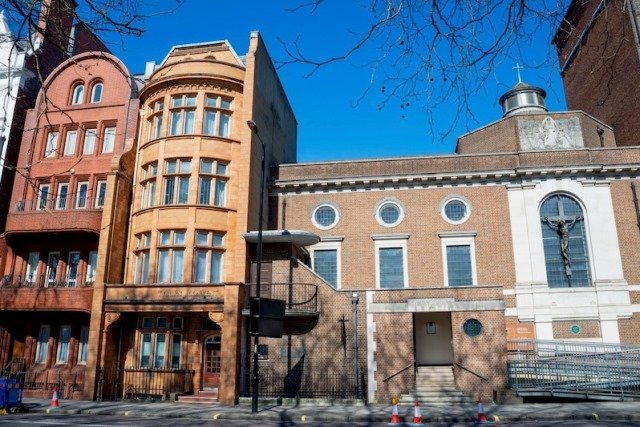
On the right in Bayswater Road is the Tyburn Convent, set up by a French order of nuns in 1903 to pray for the 105 Catholics executed at Tyburn Tree between 1535 and 1681.
-
In 1901 the French legislature passed laws placing severe restrictions on religious bodies such as monasteries and convents. A Frenchwoman, Adele Garnier, decided in 1903 to transfer her convent to London to avoid these restrictions. It became the Tyburn Convent, established in Bayswater Road, near Marble Arch.
She chose this site because it was close to the site of Tyburn Tree, where 105 Catholic Martyrs, including Oliver Plunkett and Saint Edmund Campion, were executed during the English Reformation between 1535 and 1681. The newly arrived nuns set up the Martyrs’ Shrine to honour the more than 350 Catholic martyrs who were executed in England during and after the Reformation. The convent, shown above, continues its work today.
STOP 10: HYDE PARK STREET
HYDE PARK


Travelling west from Marble Arch, Hyde Park is on your left. At 350 acres it is the largest of the central London Royal Parks. In 1536 Henry VIII seized the land to use as a hunting ground.
-
James I allowed limited access to gentlefolk and in 1637 Charles I opened the park to the general public.
Lying within the park is the Serpentine lake. There is an improbable annual custom of a public swim in the Serpentine on the morning of every Christmas day. It is shown in a VIDEO here.
One of the more remarkable recent events at the Serpentine was the 2018 installation by artist Christo (above). It was an immense floating artwork made from 7,506 stacked barrels. The 65-foot-tall, 600-ton trapezoidal barrel structure was called the London Mastaba, after the Arabic word for a bench, its shape being based on the form of stone benches that originated in Mesopotamia.
Here is a time lapse VIDEO of the building of the Mastaba.
STOP 11: VICTORIA GATE
THE CRYSTAL PALACE

Hyde Park was the site of the Crystal Palace, part of the Great Exhibition of 1851. An engineering marvel, it was constructed by Joseph Paxton of wrought iron and glass.
-
The Crystal Palace was a feat not only of design, but also of construction. It was, appropriately, 1851 feet long, and its interior was 128 feet high. It was three times the size of St. Paul’s Cathedral. The exhibition, which was opened for only six months, received six million visits.
In an extraordinary logistic operation, 14,000 exhibitors from around the world showed their wares. These comprised some 100,000 objects including raw materials, manufactures, fine arts, the Koh-i-Nor diamond, Sevres porcelain, musical organs, a massive hydraulic press, and a fire engine.
At the end of the exhition the building was dismantled, Hyde Park was restored, and the building was re-erected in the district of south London now known as Crystal Palace. Sadly it was in 1936 destroyed by fire. Here is a VIDEO from Harvard University on the architecture of the Crystal Palace.
STOP 12: LANCASTER GATE STATION
THE ITALIAN GARDENS

As Hyde Park turns into Kensington Gardens there is, just out of sight on your left, the Italian Gardens. Created by Prince Albert in 1860, they have a delightful adjancent cafe.
-
The Italian Gardens, with their pools and fountains, were created in 1860 by Prince Albert as a gift to his wife Queen Victoria. Here is a LINK to the delightful cafe overlooking the fountains, where you might like to break your journey.
THE LONDON TRANSPORT LOGO


You will see on your right outside Lancaster Gate underground station, an example of the famous roundel logo, designed by Edward Johnston for London Transport in 1919.
STOP 15: PALACE COURT
KENSINGTON PALACE GARDENS


Next on your left is the Czech Embassy, a fine piece of modernist architecture built in 1965. The wavy hammered concrete forming the wall to the street is repeated inside the building.
-
From 1965 to 1992 it was the embassy of Czechoslovakia. It luckily comprised two separate buildings, with a shared lawn.
When, on January 1st 1993, Slovakia and the Czech Republic became separate countries in the ‘Velvet Divorce’, the property was split between the two - the Czech Republic obtaining the block, in the photos above, which fronts the street.
The lawn between the two buildings continues to be amicably shared.
STOP 16: NOTTING HILL GATE STATION
NOTTING HILL GATE

Between 1714 and the 1860s there was a toll booth at Notting Hill Gate; hence the Gate in the name. The toll payments were used to maintain the hitherto dilapidated road.
NOTTING HILL GATE UNDERGROUND


At Notting Hill Gate underground, you pass over the cut-and-cover Circle & District Lines (above) of the 1880s, and the tunnelled Central Line (below) opened in 1900.
-
The early underground lines were built using the hugely disruptive cut-and-cover method. This involved blocking off the road and digging a huge trench, which was then roofed over. Some sections, as seen above at Notting Hill Gate, would be left open to the air.
From 1890 deep tunnels were introduced. The Central Line, which passes through Notting Hill Gate, was an early example of deep tunelling, opening in 1900. For these deep tunnels, the excavation was by hand, with workmen using pickaxe and shovel within the protection of a tunnelling shield, as seen below. They would hack away by hand at the face, with the soil being carried away in small trucks. The shield would then be jacked forward, and the tunnel behind would be lined with concrete.

THE GATE CINEMA
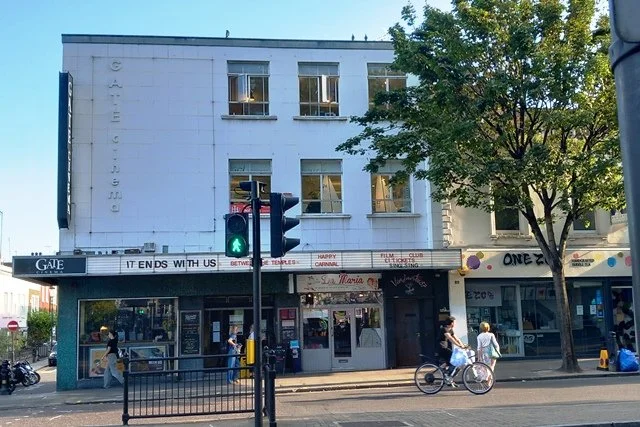

On your left, just past Notting Hill Gate Station, you see the facade of the Gate Cinema. It opened in 1911 as the Electric Palace, holding 280 seated and a further 200 standing!
-
The Electric Palace was converted from a restaurant that had been built in 1861. The floor plan of the cinema was similar to that of today, except the foyer stretched down the side of the building.
It later became The Embassy, and in 1931 was one of the first British cinemas to convert fully to sound. During the Second World War, the ornate exterior was severely damaged and subsequently replaced with a plain façade and a flat roof.
With new ownership in 1974 came the change of name to The Gate. In 2003 the cinema joined the Picturehouse family and in 2004 it received a full refurbishment.
It is now one of the finest historic cinemas in London. This LINK describes what’s on. And watch a dramatic VIDEO newsreel of the Indianopolis 500 race of 1911 - which might have been shown there in the year that the Gate Cinema opened.
STOP 17: NOTTING HILL GATE STATION/HILLGATE STREET
THE CORONET THEATRE

After the Gate Cinema you pass on your left the Coronet Theatre. The theatre was built in 1898, became a cinema in 1923, then reverted to a theatre in 2014.
-
For the history of the Coronet Theatre, follow this LINK to its Wikipedia article. The theatre’s website is on this LINK. The following introduction to the theatre is by its Artistic Director Anda Winters.
‘Welcome to The Coronet Theatre, the home of exceptional international arts in a re-imagined and restored Grade II listed theatre in London’s Notting Hill. Both its programme and the building’s restoration are curated by Artistic Director & CEO Anda Winters, in collaboration with artists from across the globe. For me, the artist is at the heart of the programme, and I work closely with the makers of the pieces I bring to London, sometimes watching and encouraging them for years. In this increasingly fractious world, I feel strongly that one of the greatest uniting forces is the international language of, and desire of all of us, to engage with art, whether as a maker or spectator. My goal is to fill the theatre spaces – the Main House, Print Room Studio, and bar – with diverse and wonderful arts from across the world, celebrating all its many forms, and the audiences who enjoy them.’
RUBY ZOE MOSAICS


After passing the Coronet Theatre on your left, you will see the mosaics on the Ruby Zoe Hotel on your right. Opened in 2023, it is one of the newest buildings on your route.
-
The developer, Frogmore, commissioned eight glass mosaics from British-Trinidadian artist Zak Ové for the ground floor facade of the hotel. The mosaics celebrate Zak Ove’s own Caribbean heritage and connection to the Notting Hill carnival.
The Artlyst website previewed the mosaics thus:
British-Trinidadian artist Zak Ové will unveil his first glass mosaic artwork in Notting Hill Gate, London. The artwork, called Jumbie Jubilation, is inspired by carnival and masquerade traditions, mythology, and the vibrant atmosphere of the area. It celebrates the rich heritage of Notting Hill Gate and Ové’s own Trinidadian heritage and connection to Carnival.
Commissioned by Frogmore, the artwork will adorn the façade of the new hotel, The Ruby Zoe. Jumbie Jubilation consists of eight floor-to-ceiling glass mosaic panels that depict a lively carnival procession. The artwork combines vibrant colours, movement, and shapes to create a joyous and celebratory procession across the panels.
In 2016, Ové was commissioned by The British Museum to create two large sculptures representing Africa’s connection to the Caribbean. He created two 7m high Moko Jumbies for the Museum’s permanent collection. Then, in 2021, he was commissioned by the AGO (Art Gallery of Ontario) to make another Moko Jumbie of a similar scale for their permanent collection.
One of the main symbolic characters in the artwork is the ‘Moko Jumbie,’ which is central to the Trinidadian Carnival and all African-based Carnivals worldwide, including Notting Hill. The Moko Jumbie is a recurring character in Ové’s work, representing the joyful spirit essential in the struggle for liberation from slavery.
In “Jumbie Jubilation,” two dazzling Moko Jumbie figures, one male and one female, wearing striking black, gold, and multicoloured costumes, will be the two central panels, larger than the other six, spiritually guiding the viewer into their world.
STOP 18: HOLLAND PARK
HOLLAND PARK AVENUE

Holland Park Avenue is an ancient road. The Romans made it their main road into London from the West, but it probably existed as a British trackway long before that.
-
The following account of Holland Park Avenue is extracted, with thanks, from the website of the Ladbroke Association which is on this LINK.
‘In Roman times it ran through a densely forested area, part of the huge forest that was later known as the Forest of Middlesex (which according to a 12thcentury description was full of red and fallow deer, boars and wild bulls).
From the Middle Ages onwards, the forest was gradually cleared, to be replaced by arable farmland and meadows. Gravel pits began to be worked at what is now Notting Hill Gate, and a straggling village developed along that part of the road at a fairly early stage.
But the Holland Park Avenue section of the road remained in open country until the early 1800s. The grounds of Holland House ran right down to the road on the south side.
In 1824, the first houses were erected on the north side between Ladbroke Terrace and Ladbroke Grove, and in the next 10 years building extended to Lansdowne Road, the farm being replaced by an inn. Almost all these houses are still standing. The two trios of houses on your right (below) at Nos. 2-6 and 24-28 with their huge and magnificent Doric columns are particularly remarkable.’
2,4 & 6 HOLLAND PARK AVENUE

Some of the earliest buildings on Holland Park Avenue are two trios of houses, splendidly deorated with Doric columns, one of which is shown above. You will see it on your right.
THE ROMAN ROAD

The Roman Road from London to Dorchester, which Holland Park Avenue follows, is shown in yellow in the map above. The form of construction used is shown below.
-
Roman roads were extraordinary feats of engineering. They were military in origin, designed to enable troops and supplies to be moved quickly from one part of an occupied country to another.
Their construction was complex. It involved digging a substanital ditch the width of the road, then filling it with four layers of construction. The lowest layer, the Statumen, was a foundation of flat stones set in cement to support the additional layers. Next came the Rudus, a layer of coarse concrete. Next the Nucleus, a layer of fine concrete. Then finally the Summum Dorsum - a layer of rectangular or polygonal paving stones. This final layer was curved to provide drainage. The road was finished off with edging stones on each side.
The Roman road along which Holland Park Avenue lies was the Roman route out of London to the west. It led to Silchester - then an important milirary base. Silchester is now a village with a population of less than a thousand, which has important Roman archaeology. After Silchester the Roman road continued to Dorchester.

STOP 19: HOLLAND PARK STATION
HOLLAND PARK UNDERGROUND STATION

You next pass, on your right, Holland Park Underground Station. The following history of the station is extracted, with thanks, from the website of the Ladbroke Assocation.
-
‘Holland Park station is one of the very few stations on the Central Line to retain its original architecture. The Central Line (or “Central London Railway”) opened in 1900 and was the second of the deep “Tube” lines to be built (the first was a portion of what is now the Northern line).
The earlier “Underground” lines like the Metropolitan and Circle lines were built using the “cut and cover” method of tunnelling, with a trench being dug and then a cover being put over the top.
Tube lines were much deeper and the tunnels were literally bored through the London sub-soil, requiring what was then a very new technology. Twin tunnels were bored, one for each direction, and the tunnels were only just big enough for the trains (unlike the more spacious Underground tunnels that took trains in both directions).
Even though the tunnels were well below the surface, they were built as far as possible under streets to avoid the risk of subsidence, and the Central Line runs under Holborn, Oxford Street, Bayswater Road, Notting Hill Gate and Holland Park Avenue.
The original Central line ran from the Bank of England to Shepherd’s Bush. The stations all had hydraulic lifts, manufactured in New York. Except for Bank (which was entirely below ground), the stations for the line were designed by Harry Bell Measures, a well-known architect of the period. All were similar, in a curious mixture of neo-classical and art nouveau, with handsome facings in beige terracotta.
According to a design in the Kensington Local Studies Library, Holland Park Station was originally intended to have an elaborate cupola at one corner (see below). But in the end, this seems never to have been built, and some of the decorative detail was also changed and simplified.
The stations were deliberately built as single storey structures with flat roofs in the expectation that commercial premises would be built on top – as indeed happened at Queensway, where a hotel was built on top of the station, and at Oxford Circus.’

STATUE OF SAINT VOLODYMYR

On your left is the statue of St. Volodymyr. The statue was erected in 1988 to mark the 1,000th anniversary of Volodymur’s Christianisation of Kievan Rus - what is now Ukraine.
-
St. Volodymyr was Grand Prince of Kiev from 978 until his death in 1015. During his early life, which was thoroughly pagan, he acquired hundreds of concubines and numerous wives.
His conversion to Christianity occured in 988. It smoothed the path for him to marry, soon afterwards, the 27 year old sister of the Byzantine Emperor, Basil, a Christian. He is revered as the father of the Ukranian nation. Here is a LINK to the Wikipedia article on St. Volodymyr.
STOP 20: NORLAND SQUARE
STOP 21: ROYAL CRESCENT
ROYAL CRESCENT

On your right is the 1839 Royal Crescent, modelled on the Royal Crescent in Bath, built in 1774. The gap between the two quadrants was required by new underground sewers.
THE MOTORWAY BOX

The roundabout at the end of Holland Park Avenue touches the southern end of the West Cross Route. This is a relic of the megalomaniac and uncompleted Motorway Box.
-
The four sides of the proposed eight-lane Motorway Box, termed the West Cross, North Cross, East Cross and South Cross Routes are shown in the plan above.
They would have destroyed huge areas of the inner suburbs. Only fragments were built, including this part of the West Cross Route, which was opened in 1970. Local protests, spiralling costs, and changed attitudes among planners caused the whole Motorway Box scheme to be cancelled in 1973.
In a kind of modern archaeology its fragments remain, much as fragments of the Roman London Wall have been preserved in the City of London. Follow this LINK for an account in the Guardian of the strange story of the Motorway Box.
And watch this VIDEO on the history of the West Cross Route. The devastating flyover below was built at the north end of the West Cross Route; if the Motorway Box had proceeded many such juntions would have been imposed on residential areas around London.

THAMES WATER TOWER

Spot in the centre of the Shepherd’s Bush Roundabout the thames Water Tower. Claimed to be the world's largest barometer, it hides a vent pipe on the Thames Water ring main.
-
The Thames Water Ring Main is a system of 50 miles of concrete tunnels which transfer drinking water from water treatment works in the Thames and River Lea catchments for distribution within central London. The initial ring was constructed by Thames Water between 1988 and 1993 at a cost of £248 million (equivalent to £638 million in 2023), and when completed, it was the longest tunnel in the UK. Here is a VIDEO from the Royal Society of Chemistry on the history of London’s water supply.
The concept for the Shepherd’s Bush glass barometer was drawn up in 1993 by Daniel O'Sullivan and Tania Doufa, students at the Royal College of Art. Their design was turned into reality by the London architects and technology consultants Brookes Stacy Randall Fursden. The tower was filled with blue water which rose and fell according to barometric pressure. The Thames Water Tower has won multiple awards including the Royal Institute of British Architects award and the Royal Fine Art Sunday Times Building of the Year Award. Sadly the barometer is no longer working. The reason is a mystery which we hope to solve
STOP 22: SHEPHERD’S BUSH STATION
WHITE CITY

After the roundabout you see on your right Shepherd’s Bush underground and the Westfield shopping centre - the site of the great 1908 Franco-British Exhibition, above.
-
The area was level arable farmland until 1908, when it was used as the site of the Franco-British Exhibition and the Summer Olympics.
For the Franco-British Exhibition (above) 20 huge palaces and 120 exhibition buildings were built on the 140-acre site by a workforce of 120,000 men.
The exhibition was eight times the size of the 1851 Great Exhibition in Hyde Park and showcased the industrial and cultural achievements of England and France. Itdrew more than eight million visitors.
Made of steel and concrete, the ornate buildings were whitewashed, hence the name White City.
During the First World War, some of the larger buildings were used for the manufacture of aeroplanes and, in the Second World War, to make parachutes. Later, film scenery was constructed in the huge spaces.
etween the wars the former Olympic stadium became a grehound racing track, which gave way in the 1960s to the building of the BBC Television Centre, described in this VIDEO. And in this VIDEO the famous Blue Peter children’s television programme takes you behind the scenes at Studio 1.
In the late 2000s the BBC Television Centre was put up for sale, much of its television production having been moved elsewhere. It was bought by the developers Stanhope and was re=purposed to add housing, office, and entertainment space, as described in this VIDEO.
STOP 23: SHEPHERD’S BUSH ROAD
SHEPHERD’S BUSH GREEN

Shepherd’s Bush is so called because here drovers bringing sheep and cattle up from the West Country would pause for grazing before the final push to Smithfield market.
-
Uxbridge Road was an important route to and from the West Country, and Shepherds Bush Green (along the right of the 94 bus route) was the traditional place for sheep drovers to fatten up their flocks after their long journey from the Cotswolds and before the final day’s journey to Smithfield Market.
For an article giving a good history of the Shepherd’s Bus Area, go here: LINK.

SHEPHERD’S BUSH EMPIRE

If you look right at the end of Shepherd’s Bush Green you will see, on the west side of the Green, the Shepherd’s Bush Empire. Built as a music hall in 1903, t could seat 2,000.
-
Charlie Chaplin, one of the early performers, can be seen on stage in this VIDEO. The Fred Karno slpastick troupe also performed at the Empire, and can be seen in this VIDEO.
In 1953 the Shepherd’s Bush Empire was bought by the BBC as a television theatre, which it used for its light entertainment music shows.The image below shows the Bob Hope Show being filmed by the BBC in 1955. Here is an improbable VIDEO of Bob Hope dancing on a table with James Cagney. Other performers who appeared at the Empire include Cliff Richard, Lulu, Cilla Black, Dusty Springfield, Shirley Bassey, Vera Lynn, Harry Secombe, Petula Clark, and Val Doonican. Picking two from this roll of honour here is a VIDEO of Cliff Richard and the Shadows, and here is a VIDEO of Vera Lynn singing The White Cliffs of Dover.
The BBC vacated the building in 1991 to move to the new BBC Television Centre at White City. In 1993 the Empire was bought by entrepeneur Andrew Mahler and it lives on today as a venue for gigs and dance nights.

THE PALLADIUM & THE PAVILION


Just beyond the Empire are The Palladium (in the two photos above) and The Pavilion (in the two photos below). Their stories are of the cinema boom and its collapse.
-
In the last few years bold re-deveopment of both buildings, retaining only their restored facades, has been undertaken by a Hong Kong company.
It is a curious reversal of fortune that Hong Kong, for more than 150 years a British colony, should now be applying its wealth to the re-development of derelict buildings in Britain’s capital.
The Palladium (above) was built in 1910 as the 900-seat Shepherd’s Bush Cinematograph Theatre. There were problems from the start. In January 1921, the manager of the Cinematograph complained to Hammersmith Council – which owned the local electricity supply station – that there was too little power available to screen films, and that therefore the theatre had to close at 6.15 pm, somewhat hampering the enterprise. He claimed compensation of £60 for loss of business.
The Palladium building seems to have suffered something of a curse as a cinema, passing through the hands of the Essoldo, Classic, and Odeon chains. Its last gasp was conversion to an Australian-owned pub, the Walkabout, shown above. This failed in 2001, and the building stood empty for many years.
Rescue came in the shape of Dorsett Hotels, part of the Hong Kong based Far East Consortium International Ltd. Dorsett obtained planning permission to demolish the building, retaining and restoring the cinema facade, and build eight stories of serviced apartments above it. The result is remarkably effective.
Dorsett Hotels had, just before, undertaken a similar rescue of the next door Pavilion, shown below. It was built in 1923 as a palatial cinema. The films were accompanied not by a mere piano but by the Pavilion Symphony Orchestra, and a sophisticated lighting system created colour effects during the films – such as blue lights for rain, or red for fire. The interior was classical in style, using three shades of copper, and seated 2,000 spectators. It had two miles of carpet and solid silver lamps for lighting. The Pavilion suffered bomb damage in the Second World War, was restored in 1955, and became a Bingo Hall in 1983. That closed in 2001.
In 2009 planning permission was given for the demolition of the building, retaining only the historic facade, and the construction of an eleven storey Dorsett hotel with a glazed roof. This opened in 2014, and is seen below.

THE SINDERCOMBE SOCIAL

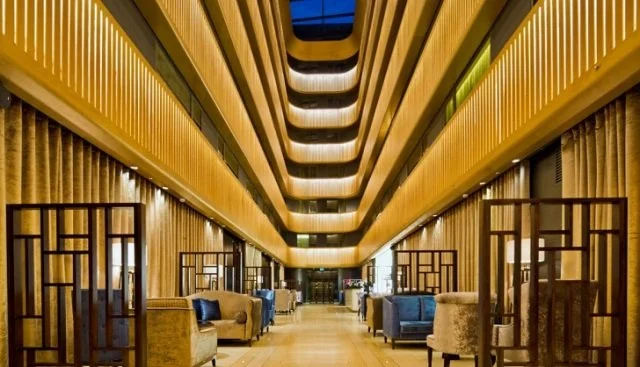
At the entry into into Goldhawk Road, on your right, is the striking Sindercombe Social. The mural is by Efomural - Luke Kerschen and Milan Szabo. Their website is on this LINK.
-
Efomural describe themselves thus:
'We are a London-based duo of visual creators with more than a decade’s experience. We want to merge our love of painting murals with our passion for interior design and spaces .
Moulded by luxury packaging, design, surrealism, visual patterns which have influenced us in our Graphic Design, Film-Making and Motion Design background. Our mission is to work towards shaping eclectic spaces, from bold realistic artworks to pure minimal abstract designs.'
Here is a dizzy VIDEO of Luke and Milan at work at the Southend festival of graffiti and street art.
STOP 24: GOLDHAWK ROAD STATION
SHEPHERD’S BUSH BUS GARAGE


Just before the railway bridge in Goldhawk Road you pass Wells St on your left. It houses the bus station within which the 94 bus is re-charged, cleaned and repaired.
-
The third turning on th left along Goldhawk Road, just before the Goldhawk Station bridge, is Wells Road. On the left side of Wells Road is the Shepherd’s Bush Bus Garage, the home of the 94 bus.
This VIDEO describes one of the current 94 buses - the 86-seater Electric Enviro 400EV.
And here is a LINK to the Wikipedia article on its maker Alexander Dennis.
SHEPHERD’S BUSH MARKET

Pass under the railway bridge and you will see immediately on your right Shepherd’s Bush Market. It sits in a narrow strip running alongside the railway arches.
-
The following history of the market is extracted, with thanks, from the Shephered’s Bush Market website at this LINK.
‘In June 1914, John Crowe, a shrewd entrepreneur, invited costermongers to set up their stalls on Railway Approach. It already had a handful of businesses under the railway arches at this time, some that had been trading since 1863 when the viaduct was first built. With Britain on the brink of war, John Crowe’s market proved to be short-lived. It was closed in 1915 to make way for the billeted troops.
The Market was given a new lease of life in 1918 as soldiers returning from the Western Front were offered stalls to help restart their lives. The market traders did their best to keep calm and carry on as the Luftwaffe’s bombs rained down on West London during the Second World War. In February 1944, during a five-month Little Blitz, a doodlebug hit the market, wiping out six shops and leaving dozens more temporarily out of action.
After the war, things gradually returned to normal. At the Market you had lovable Uncle Albert in his wire-rimmed spectacles, bowtie and baggy trousers selling toffee apples. And there was Alfred Mordeia in his apron demonstrating his eggbeater to a crowd of curious onlookers. In Ellis’s Pet Stores – still in exactly the same spot today – there was a menagerie of kittens, puppies and rabbit – as well as a talking macaw. On Saturdays, ‘Lucky’ King, the king of banjo players, one foot on his battered banjo case, brightened up the mood with his upbeat melodies.’This VIDEO takes you on a walk through the market.
THE FABRIC QUARTER

For 150 years the east end of Goldhawk Road has been a fabric quarter, with dozens of shops being passed down through the generations. Explore the Fabric Quarter in this VIDEO.
STOP 25: ST. STEPHENS AVENUE
STOP 26: CATHNOR ROAD
PIE, MASH & EELS

On your right, within the Fabric Quarter, see a Pie, Mash, Liquor & Eels shop, established in 1899 but no more. Eels, which could survive in the polluted river Thames, were plentiful.
-
Although the shop has gone, its fine lettering is well conserved.
Pie and mash shops were a popular feature of London during the 19th century, particularly in the poorer east end of London.
Pie and mash would be accompanied by jellied eels, and by a parsley sauce known as liquor.
Eels were cheap and plentiful, being able (unlike other fish) to survive in the heavily polluted Thames of the 19th century.
STOP 27: PADDENSWICK ROAD
A C AUTOMOTIVE


After Paddenswich Road, spot on the left A C Automotive. Behind its modest facade is a workshop where, with extraordinary craftsmanship, they will build your dream car.
-
In the 1930s luxury cars woud be built to order, so no two were alike. AC Automotive, behind its modest frontage, maintains that tradition today.
They build from scratch, to order, luxurious custom cars for which the buyer can specify the seating arrangements, the dashboard display, the choice of leather and wood, and the paintwork.
They start with a bought in body shell, such as the Ford Mustang (above) and go from there.
The build may take two years, and the cost of the car is typically around £200,000.
Some of their work comes via specialist dealers, such as Clive Sutton of St. John's Wood, who will represent the client and oversee the work, rather as an architect would oversee the construction of a house for a private client. Click here for a LINK to Clive Sutton.
RAVENSCOURT PARK

Just before you get to the Askew Road bus stop, there is a path on your left into Ravenscourt Park. With its delightful cafe it is a good place to break your journey.
-
Ravenscourt Park has expansive lawns, an avenue, a walled garden, ancient trees, a lake, basketball nets, playgrounds, a paddling pool, and a pleasant shady cafe - The Paddenswick Tea Gardens. The cafe website is on this LINK.
The park’s history goes back to medieval times, when the lake in the centre of the park, which is fed by Stamford Brook, was part of the moat that surrounded Paddenswick (or Palingswick) Manor.
It was only in 1888 that the 32 acre site was officially opened as public parkland. King Edward III's mistress Alice Perrers lived in the manor during the 14th century. The manor house was rebuilt in 1650 and in 1747 it was sold to Thomas Corbett who named it Ravenscourt. In 1812 the Ravenscourt House and estate were bought by its final private owner, George Scott, a builder and philanthropist who developed nearby St Peter’s Square.
Scott employed leading landscape architect Humphry Repton to lay out the gardens of the estate. The Park only narrowly escaped being built over when the Scott family sold it in 1887 to a developer.
However, fierce resistance by local residents, who had some legal rights they refused to give up, blocked the development scheme, resulting in the land being sold to the Metropolitan Board of Works which opened it as a public park in 1888.
This is a LINK to the website of the Friends of Ravenscourt Park.

STOP 28: ASKEW ROAD
STAMFORD BROOK

After Askew Road bus stop you enter Stamford Book Road, named after a tributary to the Thames that you cross at this point. It is the westernmost tributary in the map above.
-
Stamford Brook is shown above as a single blue line. But the rivers under London are much more complicated than that, as this mind-bendingly complicated description of Stamford Brook, extracted from Wikipedia, shows:
'A western headwater, the Bollo Brook or Bollar Brook, was the westernmost brook feeding the channels running through Chiswick and Hammersmith. This rose on the site of Ealing Common Underground station, midway between Ealing and Acton and travelled south, then southeast, then divided, with part channelled south to Chiswick House and Chiswick. The main flow travelled east to the north of King Street, Hammersmith.
Surface water and foul water drains beside and under short stretches of Piccadilly and District lines cut across Chiswick Common, crossing the District Line at Turnham Green tube station to reach the formerly seasonally waterlogged, low-lying area of Stamford Brook Common.
An eastern headwater rose on Old Oak Common in Acton. north east of the Old Acton Wells, and flowed south down Old Oak Common Road and Old Oak Road then down Askew Road. This course, now overtaken by segregation of surface water drainage and sanitary sewers afterwards ran the line of Paddenswick Road where it was joined by a flow emerging from Ravenscourt Park.
A middle headwater formed in North Acton near the interchange of the A40 and was known locally as the "Warple" ran southwards just west of Horn Lane, under Springfield Gardens then turned east underneath the small park, The Woodlands by Ealing, Hammersmith and West London College in Acton, ran south of Acton High Street/the Vale behind the long-established swimming location fed from the mineral wells above Acton Swimming Baths, then ran south down Warple Way, where there is a large sewage storage and pumping station. After this the brook split at The Brook public house on Stamford Brook Common. One branch from this point headed east past Ravenscourt Park and fed the former moat there.
From Paddenswick Road by Ravenscourt Park the original and middle mouth took a due south route along Dalling Road, under King Street and through Hammersmith Registry Office, Cromwell Avenue to the River Thames. This mouth, once providing high tide mooring was known as Hammersmith Creek.
The eastern mouth, Parr's Ditch, was a more complicated, field-watering affair, an alternative brook which provided irrigation of Hammersmith and continued due east through Hammersmith into a natural trough, now the long park known as Brook Green.
A ditch of the western channel was funnelled to the southern depression of parkland in Chiswick to augment the waters in the grounds of Chiswick House. Its main supply the Hazeldene ran from a lake near Sydney House to the west. The waters feed the lakes and fountains at Chiswick House, and then drain into the River Thames downstream of Barnes Bridge.
An additional western channel was added from Stamford Green, running underneath Stamford Brook Avenue and British Grove. Accordingly, elevations of Stamford Brook Avenue range from 4.8 to 5 metres (16 to 16 ft) whereas east in Ravensbourne Park, the destination of the stream depicted in early maps, the elevations are 4.4 to 4.2 metres by Paddeswick Road.
Close to the River Thames, the lower reaches of the above routes used for sanitary sewers are intercepted by Sir Joseph Bazalgette's Northern Low Level Sewer which reaches the Northern Outfall Sewer in Stratford. Directly south of the original mouth are overflow outfalls in Furnival Gardens and on Chiswick Eyot which are regularly used during rainy days.
STOP 29: FLANCHFORD ROAD
THE GROTTO HOUSE

Soon on yur left, after entering Stamford Brook Road, is the unusal gothic folly house, above. It is a design more often seen in the grounds of a stately home.
-
Grottoes of this style were a fashion in the late 18th and early 19th centuries. To add colour, some grandees would employ a full time hermit to live in the grotto.
We have not yet discovered the origins of the Grotto House, but we find its restoration won in 2014 a conservation award from the Hammersmith Society. The citation reads:
'The Conservation Award went to The Grotto in Stamford Brook Road. This is the charming and very quirky flint fronted house next to the former Duchess of Cambridge pub. (There is a companion piece hidden behind Rylett Road). This house had been delightfully and lovingly restored with some subtle changes to give it a new lease of life by its current owner, Victoria Rigby.
The attention to detail and use of correct materials is excellent and the wild flower planting in the front garden and gravel drive set off the house perfectly.'
THE PISSARRO HOUSE


Just after the Flanchford Road bus stop you pass on your left the home of the leading impressionist painter Camille Pissarro. His painting of The Avenue, Sydenham, is above.
-
Set back from the road you can just see the house, with its blue plaque for his son Lucien, behind the trees. Pissarro enjoyed painting in the open air; he is shown below doing this, with his ingenious wheeled easel.
Pissarro, who spent several years in exile in London, was a leading impressionist painter. He is the only artist to have shown his work at all eight Paris Impressionist exhibitions, from 1874 to 1886. He acted as a father figure not only to the Impressionists but to all four of the major Post-Impressionists, Cézanne, Seurat, Gauguin, and van Gogh. He moved from Paris to London in 1871 as a refugee from the Franco-Prussian war. In the same year he married his mother’s maid, Julie Vellay, with whom he had seven children, six of whom became painters.
Returning to France after the war, he found that of the 1,500 paintings he had done over 20 years and had stored in his home all but 40 had been destroyed by the soldiers who had occupied it. They had used many as outside door mats to keep their boots clean. He recovered from this setback, and continued to paint until his death at the age of 73 in 1903.
For the Wikipedia article on Camille Pissarro, click this LINK. And here is a LINK to an interactive map showing the more than 900 blue plaques in London.

STOP 30: ABINGER ROAD
STOP 31: TURNHAM GREEN STATION
THE CIVIL WAR BATTLE OF TURNHAM GREEN

At Turnham Green Station you are passing on your left the Civil War battlefield of Turnham Green. Here in 1642 the roundheads faced off the cavaliers at a critical point in the Civil War.
-
The following account of the battle is extracted, with thanks, from the website of the Battlefields Trust, which is at this LINK.
‘In 1642 the King’s army left Shrewsbury to march on London. The parliamentarians' response was to concentrate all of their available forces at Turnham Green, to block any further advance. Essex’s army had perhaps 24,000 men, facing a royalist army of roughly 13,000. The battlefield was the open space formed by Turnham Green, Acton Green and Chiswick common field.
Essex's objective of blocking the royalist advance was made easier because he was operating so close to his base. Londoners willingly sent a hundred cart-loads of food and drink to the army. In contrast, the royalists were in a largely hostile area and were short of ammunition and supplies.
Some of the senior figures with Essex hoped that the king’s entourage would be prepared to negotiate his return to Whitehall, followed by meaningful talks. This did not happen, nor did the parliamentarian commanders offer to parley.
The battle of Turnham Green became a stalemate, with the armies facing each other for ‘many hours’ until the royalists drew off during the afternoon. The parliamentarians had fewer than twenty men killed, and royalist losses are unlikely to have been higher.
Although the first Civil War continued until 1646, the royalists never again approached London, which had firmly displayed its loyalty to the parliamentarian cause. The battle of Turnham Green proved decisive in ending the royalists’ hope of capturing London.’
BEDFORD PARK


You now approach on your right a notable 19th century housing development known as Bedford Park, shown in an 1897 map above.
-
The following is extracted, with thanks, from the website of the Bedford Park Society, which is at this LINK.
‘Long considered a prototype for later garden cities and suburbs, Bedford Park is the creation of Jonathan Thomas Carr (1845-1915), a cloth merchant with liberal leanings, family connections in the world of art and a taste for property speculation, which was not always successful. He was the subject of a record 342 bankruptcy petitions.
Inspired by the Aesthetic Movement of the 1870s, Carr created an ideal suburb for the artistically inclined middle classes who could no longer afford Chelsea.
He was also influenced by men such as John Ruskin and William Morris, who lived down the road in Hammersmith. They encouraged the appreciation of beauty in everyday life as a revolt against what they saw as mid-Victorian materialism, ostentation, vulgarity and the increasing effects of industrialisation.
In a letter written in 1874 Morris said: “…suppose people lived in little communities among gardens and fields, so that they could be in the country in five minutes.”
For the full version of this article, click on this LINK.And for the history of Bedford Park, watch this VIDEO.’

ST. MICHAEL’S CHURCH


St. Michael’s Church, on your right opposite Turnham Green Station bus stop, is by the Arts & Crafts architect Norman Shaw. He also laid out Bedford Park.
-
The following is reproduced, with thanks, from the website of the St. Michael and All Angels Church:
'The first St Michael & All Angels church was a temporary iron structure in a market garden on Chiswick High Road, facing the top of Chiswick Lane. Inaugurated in 1876, its first incumbent, Reverend Alfred Wilson, soon started fund-raising for a permanent church. The present church’s foundation stone was laid on May 31st, 1879 and the building was consecrated by the Bishop of London the following year, on April 17th 1880.
However, controversy had developed over the nature of St Michael’s services.
On the day of its consecration, a letter addressed to the Bishop of London was printed in the Acton, Chiswick & Turnham Green Gazette, accusing Reverend Wilson of “Popish and Pagan mummeries”. Signed by Henry Smith, churchwarden of Chiswick, it listed his supposed transgressions: marching in procession round the church, prostrating himself before the consecrated elements, making the sign of the cross when giving the elements to the people and singing the Agnus Dei.
The controversy raged for months in the paper, which sent its own reporter who observed that the service was very “high” and reminiscent of a Roman Catholic Church.
From these foundations, the worshipping tradition of St Michael & All Angels has remained Anglo-Catholic.
St Michael & All Angels was designed by the influential Victorian architect, Norman Shaw. He is best known for the old New Scotland Yard building on Victoria Embankment, the Royal Geographical Society in Kensington and many country houses, including Cragside, a National Trust property in Northumberland.
Shaw’s biographer, the architectural historian Andrew Saint, says St Michael’s has “probably the best-preserved Norman Shaw interior in London”.
Shaw succeeded E.W.Godwin as Estate Architect for Bedford Park and also designed several of its first houses, in a distinctive “Queen Anne Revival” style, using red brick and white joinery.
St Michael’s was intended to reflect that style. It has been described by architects as “theatrical”, “a mongrel mixing of Gothic and Queen Anne”, “very novel and not very ecclesiastical”, and “a bold and perceptive character study of a community”.
Sir John Betjeman, the Poet Laureate and architectural writer, described St Michael’s as “a very lovely church and a fine example of Norman Shaw’s work.” He recalled that Shaw had written of its design, in a letter to an architect friend: “I’m a house man – not a church man – and soil pipes are my speciality.”'
Here is a LINK to the Wikipedia article on Norman Shaw.
W.B.YEATS MEMORIAL


To the west of St.Michael’s Church you can see a sculpture in memory of the Irish poet W.B.Yeats (above). It is by Conrad Shawcross, whose website is here: LINK. Yeats lived in Bedford Park between the ages of 14 and 37.
-
William Butler Yeats (born 1865) was one of Ireland's greatest poets, writers and dramatists. He won the Nobel Prize in Literature in 1923.
The family moved to England in 1867 to further his father's career as a painter. In 1879 they moved to Bedford Park, joining a thriving artistic and literary community.
One of Yeats' most famous poems is The Lake Isle of Innisfree, which reads:
I will arise and go now, and go to Innisfree,
And a small cabin build there, of clay and wattles made:
Nine bean–rows will I have there, a hive for the honey-bee,
And live alone in the bee–loud glade.
And I shall have some peace there, for peace comes dropping slow,
Dropping from the veils of the morning to where the cricket sings;
There midnight’s all a glimmer, and noon a purple glow,
And evening full of the linnet’s wings.
I will arise and go now, for always night and day I hear lake water lapping with low sounds by the shore;
While I stand on the roadway, or on the pavements gray, I hear it in the deep heart’s core.The website of the W.B.Yeats Beford Park Artwork Project is on this LINK.
STOP 32: ESMOND ROAD
STOP 33: RAMILLES ROAD
STOP 34: ACTON GREEN
YOUR DESTINATION: BOULANGERIE JADE


Having arrived at the final outward bus stop at Acton Green, walk back about 100 yards, past the filling station, to the Boulangerie Jade. It is a pleasant place to end your journey.
POSTSCRIPT: THE MOSAIC HOUSE


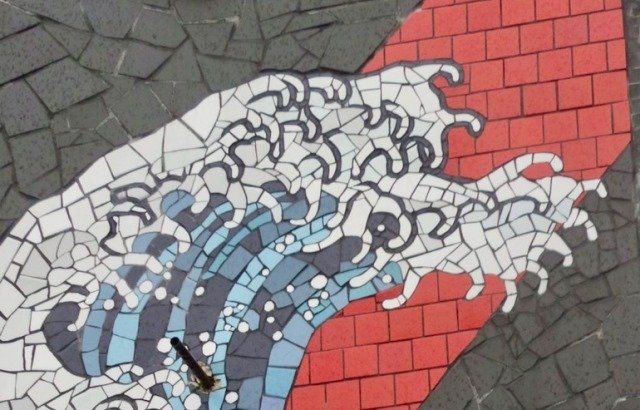
After coffee at the Boulangerie Jade, you can take a few minutes walk to the highly unusual Mosaic House, above, at 4-6 Fairlawn Grove, London W4 5EL. You walk west from Boulangerie Jade, with Acton Green on your left. Then first right into Cunnington Street, and first left into Fairlawn Grove. View the back as well as the front.
-
The Mosaic House was created by its owner, artist Carried Reichardt. Her website is at this LINK. And you can meet her on this VIDEO. The following is extracted, with thanks, from her website.
‘Carrie Reichardt's ancestry can be traced back through a long line of aristocratic eccentrics. Her grandfather, Joseph Reichardt owned estates in the Austrian Empire and was known as The Camel Hair King of America after making a fortune shipping camel hair wool from Persia via his offices in New York. He worked for the Tsar of Russia during World War I and was awarded the title of Count before fleeing the Russian Revolution.
Count Reichardt was bankrupted after losing the cutting rights to all the trees on the Caspian Sea. He moved to England with three sons. The eldest became a nuclear scientist. The youngest was Tony Reichardt, who prospered as an influential dealer in Modern Art in post-war London and was close friends with Francis Bacon. The second son was Carrie Reichardt's father Roland, who became a Rigsbyesque property landlord as well as being a faith healer with a keen interest in erotica.
Carrie Reichardt has had a career spanning many media, including film, performance and sculpture. Reichardt's preoccupation with seditious ceramics places her within an artistic tradition extending back to William Morris.
She creates anarchic artworks where vintage floral, kitsch, royal and religious crockery is given a new twist by re-firing with layers of new ceramic decals. Carrie Reichardt’s skills have been put to use as a vehicle for her political activism, most notably her campaigning for prisoners on Death Row.’
Here is a VIDEO of the event celebrating the completion of the Mosaic House. Its extraordinary craftsmanship can be seen in the detail below.
RETRACING YOUR STEPS
If you wish to recall your outward journey, here is a VIDEO of the whole outward route taken from the top of a 94 bus.